
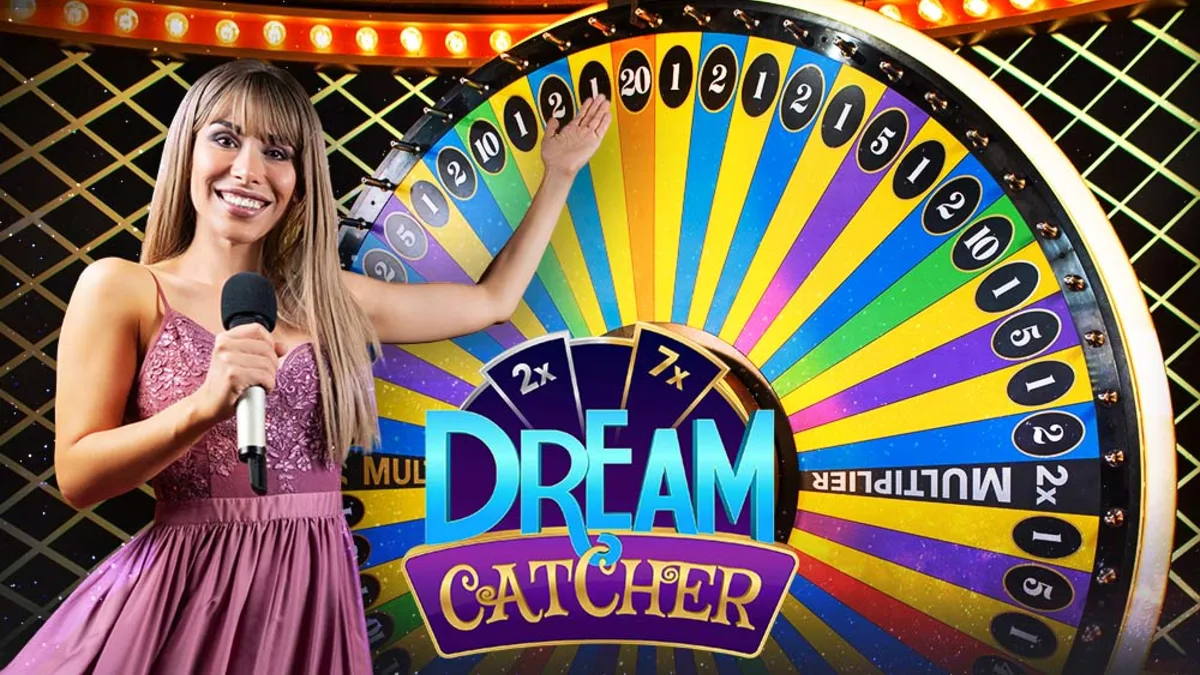
| Developer | Evolution |
|---|---|
| Release date | February 2017 |
| Theme | Money wheel game show |
| Reels x rows | 54-segment vertical money wheel |
| Paylines | Bets on 1, 2, 5, 10, 20 or 40 |
| RTP | Up to 96.58% (varies by bet) |
Before Crazy Time had its Pachinko wall and Monopoly Live had Mr Monopoly strolling around a 3D board, there was a big vertical wheel, a host and a single good idea. Dream Catcher is the game that started Evolution’s live game show business, and nearly a decade later it is still the cleanest way to understand how the whole genre works.
Evolution unveiled it at ICE in London in February 2017 as the first title in a new category it called Live Lucky Wheel. By October that year it had been named Digital Product of the Year at the Global Gaming Awards in Las Vegas, with Evolution saying it had reached slot and bingo players who would never sit down at a blackjack table. Everything that came after, from Monopoly Live to Funky Time, builds on the template set here.
How Dream Catcher works
The wheel has 54 equal segments. Fifty-two of them carry a number: 1, 2, 5, 10, 20 or 40. You bet on one or more of those numbers, the host spins, and if the wheel stops on your number you are paid at that number’s odds. A winning bet on 5 pays 5 to 1, a winning bet on 40 pays 40 to 1, and so on.
The catch is that the numbers are not spread evenly. The higher the payout, the fewer segments it gets, which is exactly how the house keeps its edge.
| Number | Pays | Segments on the wheel |
|---|---|---|
| 1 and 2 | 1 to 1 and 2 to 1 | 38 between them |
| 5 | 5 to 1 | 7 |
| 10 | 10 to 1 | 4 |
| 20 | 20 to 1 | 2 |
| 40 | 40 to 1 | 1 |
| 2x and 7x multipliers | Trigger a re-spin | 1 each |
Read that table the way the maths reads it. The 40 segment pays the most and appears once in 54. The low numbers pay little and land most of the time. Nothing about how you bet changes those proportions.
The 2x and 7x multiplier segments
The two segments without numbers are what lift Dream Catcher above a plain carnival wheel. When the wheel stops on the silver 2x or the gold 7x, nobody wins or loses on that spin. Your bets stay on the table, the host spins again, and whatever number comes up next has its payout multiplied.
Multipliers also stack. If a 2x is followed by a 7x, the next winning number is paid at 14 times its normal odds, and a run of multiplier hits keeps compounding. That stacking is where the occasional enormous Dream Catcher result comes from. It is also rare by design: two segments out of 54 is roughly a 3.7 per cent chance on any given spin, and chaining them together is far less likely again. In practice, any single round is also capped by the maximum payout limits set by Evolution and the operator, which vary from site to site.
RTP: why it changes depending on your bet
Dream Catcher does not have one RTP. Each number has its own return, because each has a different payout and a different number of segments. Operator game sheets typically quote 96.58 per cent for the best bet on the wheel, with the other numbers returning less. You will see lower headline figures quoted in some lobbies, which usually reflects a different bet being used as the reference.
The practical point is simple. The bet that hits most often is not automatically the bet that returns most over time, and the 40 segment, with its single slot on the wheel, is the long shot it looks like. Check the game’s own rules panel in the lobby for the exact figures that apply where you are playing.
Is there a Dream Catcher strategy?
No, and anyone selling one is selling you a story. Every spin is independent. The wheel has no memory, so a 40 that has not landed for an hour is no more due than it was at the start, and tracking past results does not change what happens next. Betting on several numbers at once smooths out how often you win something, but it also guarantees you lose on most of the numbers you covered.
What you can control is the session. Decide your budget before the first spin, treat it as the cost of an evening’s entertainment, and stop when it is gone rather than chasing it back.
Live Dream Catcher vs First Person Dream Catcher
The live game runs from Evolution’s studios around the clock with a real host and a physical wheel, and it is real money only. In July 2019 Evolution added First Person Dream Catcher, an RNG version with a 3D animated wheel and no presenter, which plays the same bets on your own schedule. When a free Dream Catcher demo is offered anywhere, it is the First Person version, not the live studio.
How it compares with Evolution’s newer game shows
Put Dream Catcher next to Crazy Time and the family resemblance is obvious: a money wheel, numbered segments paying fixed odds, and special segments that send the action somewhere else. The difference is that Crazy Time’s special segments launch whole bonus games, and Monopoly Live sends you round a board. Dream Catcher’s only trick is the multiplier re-spin.
That makes it the slower, simpler and more transparent of the three. If you want to understand what is happening on every spin without a rules screen, this is the one. If you want spectacle, its descendants have more of it.
Our verdict
Dream Catcher earned its place in casino history by being easy to follow, and that is still its strength. There are no hidden mechanics, the odds are written on the wheel, and the 2x and 7x segments add just enough tension to make each spin feel like it matters. It will feel bare after Crazy Time, but as an introduction to live game shows, nothing explains the format better.
Dream Catcher is a gambling game for adults aged 18 and over, or the legal age where you live. Outcomes are random, and no strategy changes the house edge. Only play with money you can afford to lose, and if gambling stops being fun, contact a support service such as Gambling Therapy (gamblingtherapy.org) or your local helpline.
18+ only. Free demos use play money. If you play for real money, set a limit first. Responsible gambling.