
NBA 2K26 brings us yet another addition of the famed MyCareer mode, which acts as both the precursor and the driving force behind the NBA 2K series’ entire online world. The mode blends offline role-playing and character building, with online reputation management and bragging rights, forming the definitive basketball experience for fans. In this guide I’ll be breaking down the mode, providing some tips and tricks to get the best out of the mode, and what you need to do to ensure you’re maximising your game time and performance.

First steps: Your MyCareer player build
If you’ve spoken to anyone about NBA 2K before, you’d have probably heard them ask what your “build” is like, or what type of “archetype” you’ve targeted. They are of course referring to your MyPlayer, or “MP”. This is the character you build when you first start MyCareer, and it is the basis for your journey. You can create multiple players across multiple slots, although generally players find themselves picking one type of build and committing to it. This is probably the best approach unwless you’re prepared to invested money in actual VC. I’ve written an article breaking down the cost of VC in NBA 2K26, as well as some VC farming tips for NBA 2K26 to help earn it quickly.
In terms of what the “best build” is, this is completely dependent on the type of player you are, and how detailed your knowledge of basketball fundamentals is. I’ve put together a guide of the best builds for NBA 2K26, as there’s also a host of different build based off of real-life NBA players, such as a LeBron James build and even a Michael Jordan build. But you don’t need to stick to these builds: you can experiment and try different things until you land on something that suits your style.
How to create a player in MyCareer
It’s fairly easy to create a player in MyCareer: simply start a new game from a new slot, and it’ll take you to the MyPlayer builder. From here, you can give your player a name and number, and choose their position, height, and wingspan.
Tips for creating a player in MyCareer
There are a few things you need to keep in mind if you’re not going to be basing your build off of the builds I linked above.
- Your player’s position will cap their total height, weight, and wingspan. This means you can’t have a 7”0 point guard, or a 6”2 PF.
- Your chosen position, height, weight and wingspan all impact the way in which attributes can be distributed.
What are attributes in NBA 2K26?
Attributes are basically the DNA of your player: they dictate how proficient your player is in a specific stat or fundamental. Your player’s body type and position will impact the maximum attribute – up to 99 – that your player can have.
For example, if you have a 6”0 point guard, this will cap their wingspan at about 6”2, which means their Driving Dunk, Standing Dunk and Post Game attributes won’t be that high, although they will be stronger in Ball Handling, Speed with Ball, and perimeter shooting. A 7”2 Centre with a 7”0 wingspan will lack pace and ball handling proficiency, but they’re going to be strong on the boards, and really with all interior fundamentals.
Which position and body types should I pick?
Again, this is totally about to you. I tend to advise newer players to pick positions that are less likely to “own” the ball, like a point guard or point forward, and instead stick to slashing Forwards and Centre positions that can establish a presence on the court, win rebounds, and dunk with ease. Ball handlers are scrutinized far more, and the game punishes turnovers, over-dribbling, bad passes and bad shots quite harshly, so these positions dictate stronger basketball IQ.
- PG/SG – Pick these positions if you are confident in your knowledge of basketball fundamentals and NBA 2K skill sets, including dribbling, passing, play calling, and mid-range/long-range shooting.
- SF/PF – These roles are easier to play but can be punished in the middle if they’re not accountable.
- C – You can create dominating, powerful, strong Centres that are fun and easy to play. My Victor Wembanyama build is one such build that can run the floor, shoot threes, and dunk the ball.
Attributions
Your attributes shape your play and ultimately where they’ll be strong. Don’t fall into the trap of stacking one particular attribute. I often see so many people pump their attribute points and VC into mid-range and three-point shots, neglecting their player’s speed, agility, defense, and ball handling. There’s no point being a strong shooter if you can’t get into position or dribble the ball in the first place.
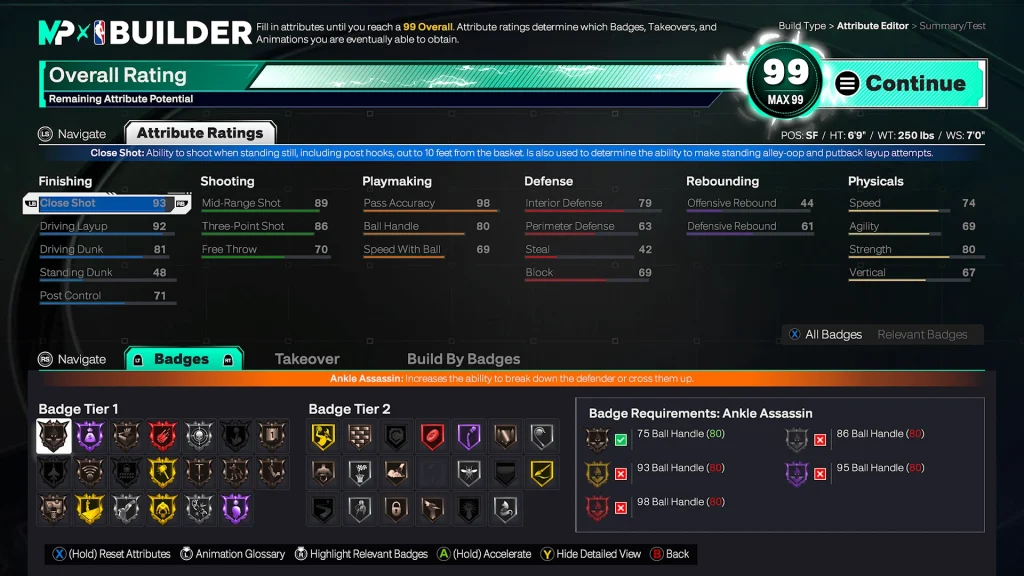
Think about the type of player you’re building, and break up that player into the different attribute types. If you want to create a Steph Curry-type shooting guard build, your player needs to be as strong with the ball as they are with long-range shooting, so your player’s handles need to be on point. It’s up to you to determine the ratio of spend here, but my general rule of thumb is to attribute a point distribution ration to each attributes field:
- Finishing
- Shooting
- Playmaking
- Defense
- Rebounding
- Physicals
So using Curry as an example, we should probably prioritise the build in the below order:
- Shooting – This covers Mid-Range Shot, Three-Point Shot, and Free Throw
- Playmaking – Pass Accuracy, Ball Handle, and Speed with Ball
- Finishing – Close Shot, Driving Layup, Driving Dunk, Standing Dunk, Post Control
- Defense – Interior Defense, Perimiter Defense, Steal, and Block
- Physicals – Speed, Agility, Strength, and Vertical
- Rebounding – Offensive Rebound and Defensive Rebound
In the above example, we are prioritising our spend on Shooting and then Playmaking to ensure our Curry build is strong with his shooting and with the ball. However, you also need to prioritise each individual attribute in the context of your build. For example, this build also needs Speed, which is an important part of Curry’s game. We don’t need to focus on Physicals broadly as much as Finishing, but his Speed is more important than his Standing Dunk or Post Control.
There is a complex middle-ground you need to find, and the further up an attribute’s ranking’s you get, the more VC you’ll need to spend to level up.

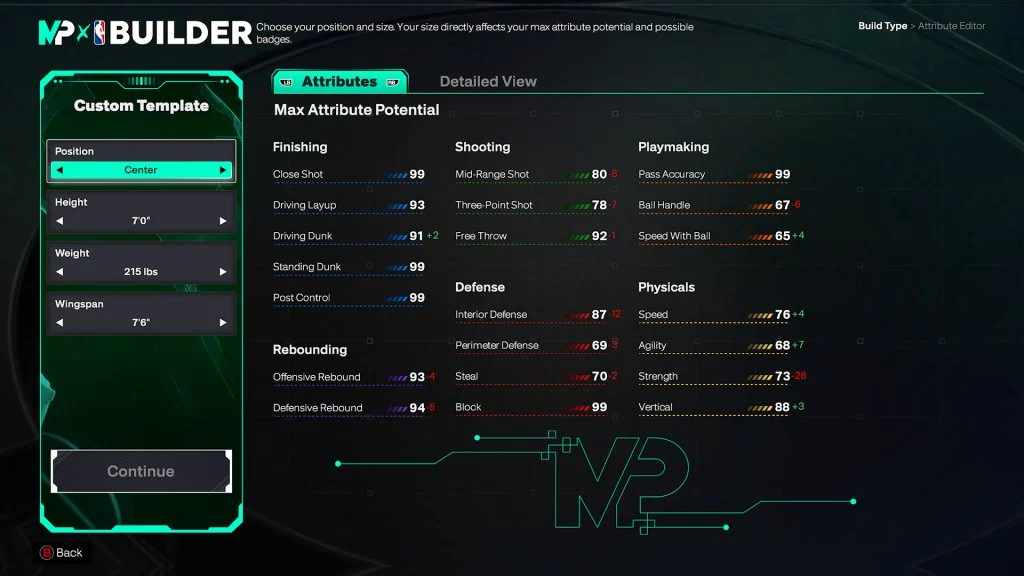
During the building phase, you won’t be able to progress until your player hits a “99 MAX Overall” ratings, but it’s worth noting that this isn’t your player’s actual rating when you start the game: it simply means that it’s the player’s total ceiling. Getting to that 99 rating takes time, patience, and a hell of a lot of grinding. You’ll start out somewhere in the mid-60s, and you’ll need to earn VC and MyPoints to level up your attributes, and increase your player’s total maximum rating, respectively.
MyPoints are essentially an experience bar used to raise your MyPlayer’s overall rating. You can earn MyPoints by simply playing the game: staying offline and playing MyCareer, or heading online to play in The REC, the City, and other quests. If you complete MyCareer questions, you can earn accelerator, which will increase the speed at which your MyPoints bar increases, thus giving you more room to play with.
Getting drafted in MyCareer
Your journey to the NBA has two pathways: the “Out of Bounds” prelude, or directly entering the NBA draft.
The Out of Bounds prelude is essentially a mini-story that showcases how your player gets to the NBA, and completing it will ultimately help boost your position in the NBA draft. You’ll play through some high school games before eventually heading overseas to play in Europe. The teams you choose don’t really matter. What matters is how you perform.
Each match you play will have some benchmarks for you to reach, mostly related to simply winning the match, and out-performing the opposition’s best player. The benchmark is relatively low: you only need to achieve a B rating in most games in order to earn the 3 star-rating, and outscore your opponent. Again, fairly easy. I’d recommend playing these matches on a low difficulty setting – I’ve written this guide that outlines how to change difficulity in MyCareer – to ensure you optimise your NBA draft number.
Once you get drafted into the NBA, your primary goal is to get into the starting five of your team, and ultimately win the NBA Championship. They both sound daunting, but with patience they are definitely achievable.
Getting an A+ team rating in MyCareer
Your teammate rating in MyCareer is basically the best way to know how you’re performing during matches. You might score 50 points, have 10 rebounds and dish out 15 assists, but if you have a C- rating, in the NBA 2K26 world you’ll be ridiculed for having a poor game. Think of it as the difference between Kevin Martin and Steph Curry: are you scoring for the sake of scoring, or are you scoring with purpose and dragging your team to victory?
How you approach and play each match depends on the position you’re playing, but I’ll break down my core tips to ensure you get the most out of the mode.

Firstly, many might argue (and I am one of those people) that the primary objective is to earn VC. One of the ways you do that is by playing well on the highest difficulty setting. But we don’t want to set the bar too high, too early, so keep the difficulty on Semi-Pro or Pro for 5-10 games before bumping it up.
Secondly, play as many games as you can, not just those games as key opponents. Those matches will grant you more rewards if you perform (and out-perform) the opponent, but practice makes perfect, so play through those not-so-important matches, as well.
Gameplay fundamentals for an A+
- Play slow, confident, and conservative: Even on the lowest settings, NBA 2K26 can punish rushed play. Don’t pass through traffic, over-dribble, or shoot over defenders. This will impact your team grade and annoying your teammates.
- Setting screens and dishing out assists will strongly boost your VC and teammate grade, so don’t hesitate trusting your team, and setting screens both on and off ball. If a teammate scores off your screen, you’ll get a “screen assist” boost. You also get a boost for a pass-to-assist, meaning your pass led to the pass that led to the basket. Good passing = good basketball.
- Don’t force shots. Know your player’s limitations. If you’re over-dribbling try to get into space, and shooting a poor shot over multiple defenders, the chances are that you’re going to miss. Missing alone and often is enough to annoy your teammates, but every single bad shot will impact your teammate grade and overall player growth potential.
- Identify your NBA 2K26 badges and their upgrade potential, and target these in your play. If you memorise your player’s badges, you’ll have a clearer picture of your player’s strengths. A Curry build, for example, will have an Handles For Days badge, meaning strong with the ball and able to dribble into space. Use this to the player’s advantage to ensure you’re taking strong, open jump shots.
- Play slow and precise … initially. While you’re getting to know your player and team, play conservatively and slowly: you’ll become familiar with the pacing of the game quickly to eventually bring up the pace. Just take it slow, pass the ball around, set screens, box out … all of the things that ultimately lead to good basketball.
All of the above should hopefully help set the scene for a strong NBA 2K26 MyCareer outing, where you can maximise VC and MyPoint earning. From there, you can build a character that can dominate in The City, and own the street courts in The Park.
Have any NBA 2K26 MyCareer tips of your own? Sound off in the comments below!